
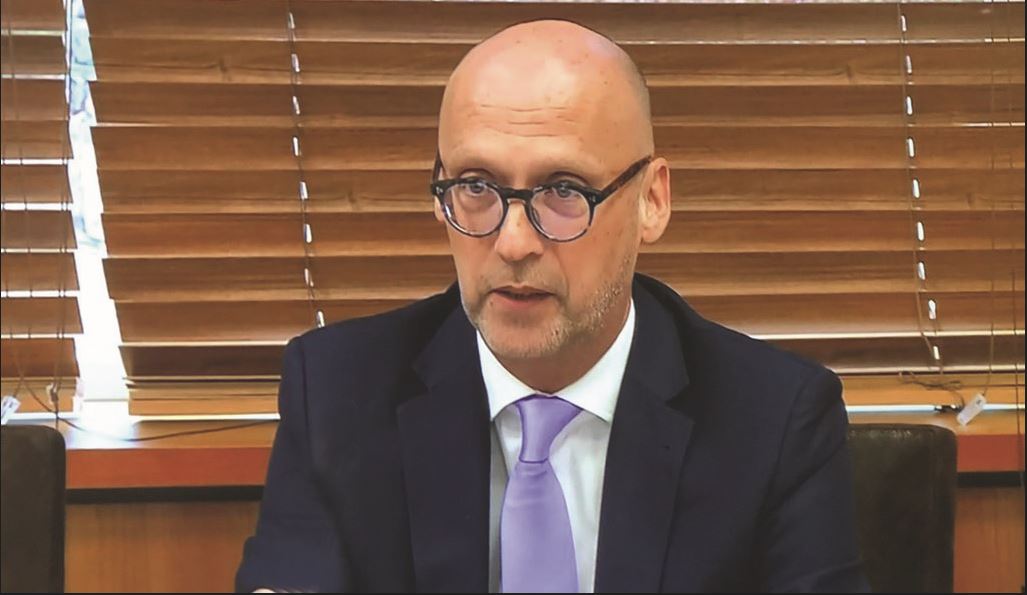
Martin Henze, former economic advisor to Chancellor Merkel, chairman of the Transport, Infrastructure and Mobility Committee of the Economic Council of the CDU North, Germany, in an interview with Telegraf, analyzed the latest developments in the world. Henze states that: Donald Trump and Friedrich Merz, who understand mutual respect, each in their own position – Merz as a European actor and Trump as US President – as well as the coalition of the willing, form a necessary and effective core team so that we can finally reach a de facto peace agreement. For this, we need action now.
Interviewed for Telegraf.al:

Engjëll Musai (Director of Telegraf)
Blerina Llalla – USA
What are your thoughts on the death of Republican Charlie Kirk?
 Every unnatural death of a human being on this planet is one too many, whether it be children, women or men. Whether in the torture chambers of North Korea and Iran, in the Gulag archipelago in Russia, in Ukraine at the hands of the aggressor Putin, in the Middle East, or in our schools, childcare facilities, universities and on our streets at the hands of people who have unrestricted access to any weapon – this also applies to Charlie Kirk. Only God, not man, had the legitimacy to take his life.
Charlie was one of the last radical Republicans in Donald Trump’s circle who still seriously believed that dialogue with leftists was possible. I have a different political perspective than Kirk in some key areas, but his openness to dialogue always impressed me. He understood that as Christians, as believers, we are all equal before our Creator. Kirk died as he lived: as a free man. On an open stage, seeking dialogue. His white shirt read “Freedom.” A hundredth of a second after the shot to the neck, the shirt was no longer white, but blood red – the result of the actions of a 21-year-old from a family of Trump supporters.
The murder of Kirk was intended to kill the principle of non-domineering dialogue between all camps in the United States.
Throughout history, we have seen such events time and again, with the perpetrators often coming from their own political and/or religious camp.
For example, the great Gandhi, a Hindu, was assassinated on 30 January 1948 by a Hindu nationalist. The first UN mediator for Palestine, Folke Count Bernadotte, was assassinated by Jewish extremists in 1948. Dag Hammarskjöld, UN Secretary-General and mediator in the Congo crisis, was apparently shot down in his plane by Belgian mercenary and fighter pilot Jan van Risseghem on his way to peace talks on Katanga. Added to this are the assassinations of the Kennedys in 1963 and 1968 and the assassination of Martin Luther King on 4 April 1968.
On 6 October 1981, Egyptian President Anwar Sadat was killed by a radical Muslim. On 30 November 1989, 21 days after the fall of the Berlin Wall, Alfred Herrhausen, who had contributed significantly to the collapse of the Eastern Bloc and German reunification, was the victim of an assassination. A year later, on 12 October 1990, my party colleague Wolfgang Schäuble was attacked. Wolfgang Schäuble, also one of the architects of German reunification, was confined to a wheelchair for the rest of his life. On 4 November 1995, Yitzhak Rabin, the Israeli Prime Minister, was assassinated in Tel Aviv by Yigal Amir. Amir was a Jewish religious extremist who opposed Rabin’s peace plans with the Palestinians. Rabin had signed the Oslo Accords, which initiated the peace process. He was shot dead after a peace rally, an event that continues to reverberate to this day.
People who pursue a mission that transcends their own religious and political boundaries live very dangerously.
Now it has happened to Charlie Kirk, a simple Republican party member who advocated open dialogue. The shot that hit him will also make history.
It is up to us to finally learn to focus on the fact that respect for people and human rights, democracy and the rule of law are the means to exchange differences of opinion and perspective in a civilised manner, to prevent violence, to declare war on radicalised actors of all stripes, and to enable cultural development.
The war criminals, autocrats, socialists and radicals of this world – whether they are called Putin, Kim, Rama, Díaz-Canel, Morales or Khamenei – should know that we will never allow our freedom to be taken away or destroyed. Whatever may come, we will fight.
What is your position on the negotiations with Putin? He was given the red carpet treatment in Alaska. Does Putin need concessions to moderate his behaviour?
Well, at the present time – whether here in Germany, in Albania or in the USA, including Alaska – something completely different is needed.
You don’t pet a sick dog when you put a muzzle on it. You say “Sit!” and put it on. If it barks, you give it a firm slap on the snout – and that’s it. If you have your head in a hyena’s mouth, you don’t negotiate.
It’s similar with Putin: there’s no point in appeasing him. What matters is what clear demands are made. And that’s exactly what’s missing at the moment. Everyone is talking about “negotiations”, but no one is saying what the end result should be.
It is only thanks to our Chancellor Merz that Europe is beginning to put itself in pole position. Some of Trump’s advisers dream up absurd ideas such as “Let’s ally ourselves with Russia against China”. That is basically an admission of defeat.
Some of the people surrounding Trump are foolish opportunists. He has hardly any friends or reliable experts. Rubio and Vance are good people, but that is not enough. There is a complete lack of clarity in Washington – and this at a time when we are on the brink of a Third World War. The diplomatic chaos and Trump’s poor advice must come to an end. This means we must clarify what we want from Ukraine and Moscow, how this war should end and what the world should look like afterwards.
Instead of talking about nonsensical security guarantees or some kind of economic agreement: who wants to invest in Russia from the US economy or from Germany?
No one who can think clearly. Russia is a dictatorship, the work ethic is poor, there are few well-qualified workers, alcoholism is widespread and the mafia lurks around every corner.
So first of all, goals must be defined and, at the same time, it must be clarified how we can ensure continuity of objectives.
During this clarification phase, Ukraine must be provided with everything it needs in terms of military equipment and expertise to protect its own territory. At the same time, we must and will increase economic sanctions to reduce Putin’s foreign trade to almost zero.
All Russian foreign accounts should be frozen. I think that within four weeks, the Russian economy will come to a standstill and the Russians in Moscow and Sochi will have finally and definitively resolved the problem with Putin, Lavrov and the other Putin actors. This will allow peace negotiations to begin and Russia to become part of Europe again.
So: less talk, more action and getting things done.
Vance recently said that all wars end with negotiations. What do you think?
You see, I have a lot of respect for J.D. Vance, he is a good Republican and Christian, but what he said is nonsense. Negotiations per se mean that each side makes sacrifices, not that Russia is simply allowed to keep the occupied territories. Genuine, substantive negotiations would take place if the war criminal Putin withdrew his troops from the independent state of Ukraine or even ceded the occupied territory. Crimea should be granted special status due to its history, demilitarised and placed under UN administration, accessible to both warring parties.
Anything else is pure nonsense. Vance demonstrates a fundamental ignorance of history, not because he lacks knowledge, but because he is highly educated and is merely trying to justify Trump’s approach to conflict resolution. This is wrong. Trump needs to be advised openly and in a more goal-oriented manner. Celebrating an echo chamber for Donald Trump is counterproductive.
The US must position itself more clearly and with greater foresight. Trump needs specialists at his side who have experience from the period before 1989 to the mid-1990s. It is not enough to hear everyone saying: Well done, USA. The task now is to forge such a close alliance between the USA and Europe, and Germany in particular, that there is no room for disagreement between us. Together, we want to secure freedom, not socialism or a third world war.
Trump must immediately influence Putin’s “friends”, Orban and Fico, to stop opposing economic sanctions and to buy oil and gas from the USA instead of Moscow. It is time to give the two of them a one-way ticket to Moscow. We can gladly share the cost of the tickets between Berlin and Washington. We can take these two people, Vucic, with us. They are harming their own nations, the peace talks and thus the reputation of the USA. They are harming Europe, Germany and the USA.
So no negotiations with Putin?
It takes two to tango. As I said, Putin does not want to negotiate. He will only want to negotiate when he may no longer be around for biological reasons or when he realises that it is becoming more dangerous for him, his family and his colleagues from the FSB and the oligarchy not to negotiate. Ukraine’s strategy is increasingly paralysing Russia, with the attacks on depots and the Russian oil industry in particular being the final nail in the coffin for Putin’s rule. The guys in Kiev are doing a very good job.
But if the US in particular, as well as parts of Europe and the Balkans, let Putin get away with everything, why should he seek a compromise?
When you get everything handed to you on a plate, you have no reason to negotiate. The US President should know that too.
I think that Donald Trump and Friedrich Merz, who respect each other, each in their own position – Merz as a European player and Trump as President of the US – as well as the coalition of the willing, form a necessary and efficient core team, so that we can ultimately arrive at a genuine peace treaty. To achieve this, we now need action.
The political situation in Germany?
This question is complicated and cannot be explained in a few words. But perhaps I can point out three areas that we are currently dealing with.
Firstly, Germany was unlucky. Just as we in Berlin were beginning to address the problems of the 2015 refugee crisis – that was around 2020 – the coronavirus pandemic broke out. Once that was over, we were challenged by Putin’s war of aggression in 2022.
And thirdly, the efforts of the red-green government in Berlin between 2021 and early 2025 were characterised on the one hand by chaotic solutions that bypassed the German people. On the other hand, a political coalition of Greens and Socialists in leading positions was unable to solve complex problems in a disruptive situation. They used linear solution concepts that did not work and failed miserably. In the following four years, there were hardly any positive developments politically or economically. The standstill caused the problems to grow exponentially.
And what will happen after the election in spring 2025?
The Chinese strategist Sunzi, the counterpart to our Prussian general Clausewitz, once said that people can only find a way out of a crisis when they have their backs to the wall and believe they are about to die.
Germany has its back against the wall, which is leading to a new willingness to think more geopolitically than in 2024.
In April/May 2025, there was a real sense of optimism in Berlin, but things have calmed down a bit now.
In fact, with Chancellor Merz, we have a very influential and highly effective politician who is also de facto foreign minister. He excels in both roles and, as a lawyer and former entrepreneur, also has extensive expertise in economics and finance. Furthermore, in Alexander Dobrindt, we have a very well-organised home secretary who, among other things, is successfully addressing the issue of asylum.
Unfortunately, the junior partner SPD is currently behaving as if it had won the general election, even though it lost it spectacularly. In this respect, it certainly needs to broaden its perspective even further and take the country’s real problems seriously, otherwise it will not succeed.
In particular, the economy must grow, which means that tax cuts and investment programmes are necessary.
We have designed the latter in the form of so-called special funds to finance the renewal of our infrastructure to the tune of €500 billion, as well as for defence and infrastructure, i.e. with no upper limit.
These two programmes are the largest investment packages ever conceived in Europe. I think this is our ticket to the 21st century.
Germans have a unique talent. Once they have emerged from their depressive corner and clarified what needs to be done, they can perform miracles. After the Second World War, we rebuilt a country that had been almost completely destroyed, with important industrial centres in Eastern Europe that had been lost, and which also had to take care of over 11 million German refugees from Eastern Europe. Within less than two generations, we developed it into the second largest economy in the world. We are capable of anything, we just need a goal – that is typically German. That goal is now in place, and now we wait to see what happens.
I am very confident.
These economic programmes will also motivate the entire European and US economies.
A particular problem is the Putin-affiliated parties: AfD, BSW and Die Linke. De facto, all three organisations are Moscow-oriented, left-wing parties. They are all, some more than others, opposed to NATO and the EU and would like to negotiate with the war criminal Putin. Parts of the SPD are also among them. When I meet these actors, I am always reminded of Moscow’s fifth column. They all seem like Orbán and Fico, as if they were remote-controlled. In my opinion, they do not represent the interests of the German nation and our Western partners.
There are discussions about banning the far-right AfD party in Germany, aren’t there?
Yes, but on the one hand, the AfD is not far-right, it is Moscow-oriented, so it is not right-wing per se, and on the other hand, this is something that can of course be considered in a constitutional state.
In my opinion, a democratic society must be able to withstand democratic debate, and I agree with Vance in his criticism. However, what is necessary here, and what Vance failed to take into account in his criticism at the Munich Security Conference, is that every party must abide by the constitution and democratic rules. So if a party is unconstitutional, it has no place in our country.
This is what we did with the German Communist Party in Germany. It was classified as anti-constitutional by our Constitutional Court and banned; its members were no longer allowed to work for the state and were barred from certain professions. That was the right decision, and it still applies today. Vance should not tell us what to do in this area; the Americans did the same thing with communist platforms in the United States.
Such organisations have no place in our free societies; they are, by their very nature, enemies of democracy.
Now, however, numerous voters are turning away from the Left Party and the SPD and voting for the AfD, for example, which is now to be banned.
It is curious, however, that it was the Left in Germany who wanted to prevent this party ban against the communists at the time, but are now in favour of a party ban against the AfD because, in their view, it is a right-wing extremist party.
So, as always, I do not trust the arguments of socialists. Socialism can never be democratic, so their current argument for banning the AfD is ultimately only about eliminating an opponent. The Conservatives have also put forward arguments, and I think they have honest intentions; they are concerned with protecting our democracy, i.e. freedom.
We will see what the Constitutional Court says and then bow to the ruling.
However, banning parties does not actually resolve the current conflict.
German politicians must try to alleviate people’s fears about the future. This can be achieved through excellent economic and defence policies, reform of the welfare state and the demonstration of strong leadership.
On the other hand, we must prevent Moscow and Tehran from interfering in our society via social media in the spirit of hybrid warfare in order to manipulate people. When Putin disappears, the so-called populist parties will also disappear – including Vučić and Rama, by the way – it’s as simple as that.
What role does Germany play in maintaining stability in Europe?
Well, you see, the German economy is innovative and strong. Our gross domestic product is twice that of Russia. Europe is the largest single market in the world and has the highest gross national product worldwide. We need to organise our economic, social and foreign policy in the EU in a slightly more focused way, but we will achieve that under Friedrich Merz’s chancellorship.
Germany is taking responsibility; Germany is back on track.
The world is changing – and Germany is changing with it.
But one thing remains the same: we stand firmly alongside our partners and alongside Ukraine. In a changing world, we defend our values: freedom, openness, security and democracy – without ifs and buts. “We know that peace cannot be taken for granted. And we act accordingly.” Friedrich Merz said this some time ago, and I can add nothing to it.
This means taking a clear stance towards Russia, strengthening NATO and the EU, providing new responses to new threats in the areas of economics and defence, and assuming responsibility in the world, in Brussels and in our own country. Security is not a feeling. Security is a task. And we are taking it on.
For a long time, Germany was regarded in Europe as a hesitant giant. But geopolitical upheavals, growing expectations from partners and a new self-image demand clarity and leadership.
The foundations for a stronger role for Germany in Europe have been laid.
In the past, German governments have often been conspicuously reticent. A prime example is the “German vote” of the left wing from Berlin in Brussels, which did not mark any position at all, or compromise lines that were directed internally but had no effect externally. In its coalition agreement, the new federal government has set itself the goal of making European policy coordination more stringent and giving the Chancellery a stronger role as a control centre. Friedrich is currently taking on this role and coordinating very well with his friend Donald Trump.
In short, this means that European defence needs German initiative and leadership, we will rethink financial policy at home and in the EU, Europe must become even stronger, and we will revitalise bilateral relations with Paris, London and Warsaw. The EU needs reforms and unified leadership – we will ensure that this happens. Germany is part of Europe, and we will now make this even stronger together with our partners.
So, Germany is not experiencing an identity crisis. We have been in a disruptive phase worldwide for years. However, Germany is now responding with full force.
The Balkans and Albania: how do Berlin and Brussels view the Rama administration?
According to information from security circles and intelligence services that regularly operate in many countries, Rama’s government is a mafia government, as the BILD newspaper aptly pointed out. The executive branch is one of the most corrupt in the world. Albania is de facto the centre of money laundering and gambling, as well as a hub for cocaine and amphetamine trafficking between South America, Latin America, the US and Europe. Russian oil also appears to be transported via Albanian ports. Elections are consistently manipulated. Where money laundering is carried out on a large scale, as in Albania, international terrorism is also financed.
Massive currency speculation cannot be ruled out either, given that the autocratic government controls Albania’s state bank. It is as if Olsi Rama were running a state-owned casino. The difference is that in a casino, money cannot be printed and government bonds cannot be issued.
Added to this is the cooperation between Soros and Rama, as well as the involvement of the US Embassy in Tirana. Donald Trump must now finally take action and not just talk. Such cooperation must be thwarted and the players involved must undergo serious interrogation by the FBI and the DEA.
It is time to send the cavalry to Tirana.
What should we do in Albania?
I have a clear position on this. If we and the Albanians do not work to remove the Rama government and bring it to justice, Albania will become a second Venezuela or Mexico, i.e. a narco-state in the middle of Europe. Nobody wants that.
We now have the opportunity to support the Albanian people in their efforts to end the rule of the Rama mafia. It is our duty to seize this opportunity from Berlin, Brussels, London, Washington and Albania.
So does the way out of the crisis in the Balkan Peninsula lie in a change of government in Tirana?
We must be clear about one thing: this is about change from within, by the Albanian people. This is not the Balkan War. It is not about using European or American military power to overthrow the regime of rogues in Tirana who are embezzling, i.e. stealing, US/EU and Albanian taxpayers’ money through corruption. Rather, it is about using our capabilities to force the government to choose between resigning or repaying the billions of US dollars and euros they have misappropriated over the last 12 years within four weeks.
So it is not a question of overthrowing the government from outside, but of gaining time. This time should then be used by the organised Albanian opposition, i.e. civil society. We know that it represents the majority of Albanians.
The Albanian people have the right to self-determination and the right to a government that is freely and democratically elected and guarantees the same fundamental human rights as governments in the West. We now have the opportunity to help the Albanians.
Why do you believe that a change of government in Tirana is the most promising way forward?
Firstly, it is not a government in Tirana. The Rama administration has legitimised itself since 2013 through rigged elections – so, legally speaking, no election has taken place.
The administration has now implemented a so-called AI-controlled minister who is apparently responsible for fighting corruption.
This is a perfect method for what the BILD newspaper calls a mafia government to now engage in large-scale corruption with impunity – only the AI figure is liable.
The opposition can also be combated in other ways, as the AI minister’s database is in Rama’s hands.
It can be programmed to act in a value-oriented manner, so that evidence can be generated primarily for the prosecution of the opposition without any member of the administration being held responsible for this breach of the law.
Incidentally, under Albanian constitutional law, it is not permissible for an IT machine to replace a minister who is not subject to any control or responsibility and is also unable to interact independently.
Opposition members are imprisoned before or after elections on the basis of falsified and/or unfounded factual statements, as the administration sees fit.
The rule of law, democracy and freedom of the press are now dysfunctional.
In this respect, I do not believe that there is any viable option other than a change of government and new elections under international supervision.
We have tried to influence the Rama system through numerous discussions and meetings on the part of the EU and Germany. However, the regime has repeatedly found loopholes to evade the system change. Rama’s political dementia was astonishing: in a TV interview, he stated that he was not familiar with the EU’s 10-point criteria catalogue for Albania’s accession to the EU, even though he had officially received the document from Berlin and Brussels.
Supporting democratic change by removing the illegal Rama government is not only strategically correct, but also morally imperative towards the Albanian people, especially children and the elderly, as well as the many Albanian expatriates who have fled the country and whose future in Albania has been stolen by the Rama organisation.
We should make our support for the organised Albanian opposition and for the Albanian people in their quest for freedom and a future in the EU and the Western community clearer than we have done so far.
In this context, we should also make it clear to the Albanian people that Albania will never become a member of the EU as long as an administration like Rama’s is at the helm of the Albanian state, whose executive branch steals the tax money provided to the Albanian people by European and American taxpayers through corruption.
So it is not a question of imposing something on Albania from outside. It is a question of fulfilling our moral obligation to our own citizens and bringing about a democratic outcome that will enable the Albanian people to free themselves from a brutal regime. This regime is also responsible for the fact that over a million Albanians have fled Albania since 2013.
Negotiations with Rama are not working?
I do not believe that we will reach a negotiated solution with the Albanian government.
You see, in August/September 2019, we adopted a 10-point list of criteria in the German Bundestag and the European Parliament, which is based on the Copenhagen Declaration. This document sets out many obligations, including the prosecution of those responsible for electoral fraud in the 2017 parliamentary elections.
There are audio recordings, mobile phone recordings and written documents to support this. Has Rama been charged?
No.
Did the prosecutors and police officers who uncovered the scandal flee Albania?
Yes, some have found asylum in Switzerland, others in Germany.
In that case, why should we still negotiate with thieves in the Balkans?
Thieves belong in a proper court of law; they must feel the crooked stick of the rule of law.
How is the Albanian opposition supposed to organise resistance when its leaders are persecuted and discredited with forged documents?
Yes, that is certainly an issue, but it is negligible.
The crucial question is: does the Albanian people want a future?
I do not believe that the strength or ability of a regime to remain in power can be measured solely by the extent of its potential for oppression or its media power.
This kind of power can quickly vanish into thin air when the pressure mounts.
In Albania, 1-2 hours are enough and Rama’s time is up. We know where he and his friends have hidden their capital.
Just think of the year 1992 in Albania: it took courageous Albanians to remove Hoxha’s regime of terror and oppression.
The communists had just enough time to move Albania’s state assets to safety in France, where they still remain today, waiting for the Albanian nation. Much of it has also been reinvested in Albania, but many Albanians are unaware of this. We know where it is.
Do you think the US government or the Europeans will recognise the opposition?
I think Trump and Europe have realised that this regime in Tirana cannot reform itself. Trump has also realised that Rama’s friend Soros Jr. has a high affinity for Rama and Albania.
Rama survives by rigging the elections in Albania, and the election rigging has only one winner: Rama.
Ambassadors and politicians are bribed or blackmailed.
During Rama’s reign, drug trafficking, human trafficking and money laundering have grown exponentially.
This is a regime whose interests do not coincide with ours.
Is this just rhetoric, or do you really believe that Albania will become a member of the EU?
Yes, anything is possible, but not with a criminal government.
Every Albanian will understand that we Americans and Europeans will not allow ourselves to be robbed by the corrupt Albanian executive and therefore cannot work together in an economic community, especially since some of them are involved in a corruption scandal with the Russian mafia, as in the case of FBI Director Mc Gonigall.
We can provide stronger moral support to the Albanian opposition, as we did in many countries in 1989.
President Reagan had to fight against his own bureaucrats, ambassadors and advisers to do so. That is exactly what we need now in Washington, London, Paris, Berlin and Brussels. Our bureaucrats, some of whom have been bribed, will comply. If we continue the policies of the past in a different format or under a different name, it will lead to the same results as in the past. It may look different on the surface in Albania, but at their core, the Albanians will inevitably come to the same conclusion if they and their companies want to survive.