
INTERVIEW FOR TELEGRAF NEWSPAPER by:
Engjëll Musai, Telegraf Director
Blerina Llalla, political editor


Albania’s Navalny Moment?
Ilir Meta served as President of the Republic, Prime Minister and Speaker of Parliament. Today, one of the best-known opponents of the Rama government has been held in pre-trial detention since 21 October 2024. His guilt has not been established by a final judgment. Reports describe him as being alone in a cell and almost completely isolated. His lawyers have informed the Ministry of Justice in writing that confidential meetings with him were conducted under camera surveillance. The case has therefore long since come to concern more than allegations of corruption. It raises a fundamental question for a candidate country for EU accession: where does the power of law end – and where does the law of power begin?
| Key thesis The rule of law is not measured by how uncompromisingly it can pursue its opponents. It is measured by how uncompromisingly it protects their rights while pursuing them. |
The title of this interview is ‘Albania’s Navalny Moment?’. Is that not a grossly disproportionate comparison?
Henze: It would be, if one were equating Ilir Meta with Alexei Navalny. Albania is not Russia. Rama is not Vladimir Putin. But Rama and Putin have something in common: they are autocrats, and the system for which they bear responsibility is corrupt to a very high degree; or, more simply put, it is criminal.
And Ilir Meta is not Alexei Navalny.
Navalny was poisoned, arrested after his return to Russia, repeatedly prosecuted, imprisoned and increasingly isolated. He died on 16 February 2024 in a Russian penal colony. In his case, the European Court of Human Rights went exceptionally far. In 2018, the Grand Chamber found not only violations of his rights to liberty, procedural rights and freedom of assembly. In relation to certain arrests, it also found a violation of Article 18 ECHR: the measures had pursued an ulterior purpose, namely the suppression of political pluralism. The Court expressly considered the sequence of events and the political context.
No such judicial finding exists in Meta’s case.
But that is precisely why Navalny is not being used here as a label. He is a warning.
The decisive question is not: Is Meta already Navalny?
It is this: how early must Albania, Europe and the rest of the civilised world take notice when state measures directed against a leading opposition politician may be coalescing into a pattern, and when the possibility exists that the former President might coincidentally die in detention or shortly afterwards?
What would that pattern be in Albania?
Henze: We must first step back from the individual criminal proceedings. Rama’s Socialist Party, the successor organisation to Albania’s Communist Party, has governed Albania since 2013. A long period in office is, of course, no proof of authoritarianism. A party may repeatedly win democratic elections; they simply have to be conducted democratically, and the government must comply with the Constitution and the governing institutional framework. The duration of power becomes relevant where the state and the governing party become increasingly difficult to distinguish from one another.
And on precisely this point there is now a remarkably long record of international election-observer reports, analyses and opinions of the Venice Commission. In 2017, ODIHR reported continuing politicisation of institutions, widespread allegations of vote-buying, concerns about the misuse of state resources and pressure on voters in the workplace. At the same time, the organisation expressly found that fundamental freedoms had been respected and that candidates had been able to campaign freely.
In 2019, in what was a false-flag campaign, the so-called opposition figures Basha, Tabaku and others organised non-participation in the local elections and withdrawal from Parliament. The result was that the Rama organisation filled all leading state positions with its own people. Albania has de facto degenerated into a one-party state, notwithstanding the continuing existence of an opposition.
In 2021, the diagnosis was again ambivalent – and for that very reason revealing. The election offered a genuine choice, fundamental freedoms were generally respected and election day was largely transparent. At the same time, according to ODIHR, the governing party enjoyed a substantial advantage through its control of local administrations and media and through the misuse of administrative resources; allegations of vote-buying were widespread throughout the country and were also documented.
In 2021, Basha, Tabaku & Co., operating under a false flag, attempted to take over the Democratic Party of Albania. When that failed, the then US Ambassador Kim, who was well acquainted with Rama, was used to subject chairman Sali Berisha, on the basis of false Albanian documents, to a so-called persona non grata decision by the US State Department. Berisha was thereby to be eliminated once and for all. When that also failed, politicians operating under a false flag, such as Basha, Tabaku and other scoundrels, occupied the headquarters of the Democratic Party of Albania on the black Saturday of 8 January 2022, barricaded it with steel plates and vandalised it. When opposition MPs of the Democratic Party, its executive and members sought to enter their party headquarters, they were confronted with iron bars and gas; Basha then arranged, with the assistance of police officers of the Rama organisation, for the de facto owners of the party building to be driven out by the use of gas.
At the 2023 local elections, ODIHR again documented instances of misuse of state resources, allegations of pressure on public-sector employees and voters, and allegations of vote-buying. In 2025, international observers put the matter particularly clearly: the parliamentary election had been competitive and professionally organised – but the contestants had not enjoyed a level playing field. The governing party had benefited from widespread use of public resources and institutional power; there were also numerous reports of pressure on civil servants and other voters, as well as instances of intimidation and offers of state employment. The Venice Commission’s requirements for restoring democratic electoral legislation had repeatedly not been met.
Since 2013, this has been a grave political development: elections take place. Competition exists, but it has been neutralised in different sectors. The so-called incumbent enjoys structural advantages that recur across several electoral cycles. No democratic election has taken place since 2013. Europe’s largest newspaper, BILD, has described the Rama administration as a MAFIA government.
Does that make Albania a one-party state?
Henze: In constitutional terms, clearly not. Opposition parties are lawful. They stand for election, demonstrate and have members of Parliament and political organisations. But the country does not hold democratic elections.
The more demanding question is this: is Albania developing the characteristics of a dominant-party state in which opposition formally exists, but in which a genuine transfer of power is becoming ever more difficult because of structural asymmetries?
Modern democratic erosion does not require the banning of parties or the abolition of elections. It may manifest itself in a governing party accumulating administrative power, state resources and communicative dominance over a long period, while the political costs of effective opposition continue to rise.
ODIHR found in 2025 that political competitors did not face a level playing field. Reporters Without Borders also describes structural threats to press freedom arising from links between politics and business, an inadequate legal framework and politically partisan regulation. That is not a description of a totalitarian state. It is the description of a system with substantial asymmetries of power that is degenerating into a party autocracy whose administration is, in substance, composed of criminals; Tahiri and other actors are cited as examples.
But Albania is emphatically pro-Western. Rama wants to lead the country into the European Union.
Henze: Formal statements do, indeed, suggest that. But, as the Bible says, by their deeds shall you judge them. Rama and his administration cannot, per se, be seeking EU membership; for such a corrupt government, that would in itself amount to suicide. As early as 2019, when he gave a press interview, Rama did not consider himself bound by the Copenhagen declaration and the decisions embodied in the ten-point programme for Albania adopted by the German Bundestag and the European Parliament; he denied that they existed.
This is not a classic conflict between a pro-Western opposition and an anti-Western government. Ultimately, the question is whether Europe is prepared to cooperate with a corrupt government and an administration that, together with Vucic and Lavrov, is working on an anti-EU model, the Open Balkan project.
And does the EU want that?
Henze: I have the impression that there are differing perspectives among the EU states and the United States. Albania should become part of the EU. But a criminal administration that also bears responsibility for the exponentially growing cocaine and money-laundering trade has no place in the institutions of the civilised world, nor in the United States. Rama and his comrades have embezzled too much international aid money in recent years; the sums run into billions of euros.
The decisive question is therefore not: who is pro-Western? Rather: what does the West mean? Is ‘pro-Western’ a geopolitical category – NATO membership, Brussels, Washington? Or does the term also denote an internal political order: separation of powers, a genuine possibility of alternation in government, an independent judiciary, free media, protection of the opposition, proportionality in the exercise of state power, and a criminal process in which the government’s fiercest opponent enjoys the same rights as its closest ally?
A country can be Western-oriented in foreign policy while becoming increasingly criminal and authoritarian at home. That is precisely why geopolitical loyalty must not earn a discount on the rule of law.
Where does Ilir Meta fit within this structure of power?
Henze: Meta was one of the few politicians who, at the highest institutional level, stood directly opposed to Rama for years and sought to protect Albania’s Constitution. His conflict with the socialist majority began when, years ago, he split away with a section of the members of Rama’s party and organised a democratic alternative. From the perspective of his former party colleague Rama, that was an open affront; Rama has never forgiven Meta for it.
As President, he entered into a serious constitutional crisis with the government and the parliamentary majority in 2019. After his decision to postpone the local elections, because only parties of the Rama organisation were standing and the opposition parties declined to participate, impeachment proceedings were pursued. The Venice Commission reached a nuanced view. It considered it possible that Meta had exceeded the limits of his constitutional powers. At the same time, it specifically questioned whether that conduct reached the exceptionally high threshold of a serious constitutional violation capable of justifying impeachment.
His efforts to oppose the demolition of the old theatre in Tirana should also be recalled.
A further attempt by the Rama organisation followed in 2021. The Socialist-dominated Parliament voted to impeach Meta. But Meta was not removed from office. In 2022, the Constitutional Court withheld the confirmation required for his removal. The background was that Europe and the United States attached importance to a neutral decision. Meta remained President and completed his term in the ordinary way until July 2022.
At the same time, the Constitutional Court itself remained dysfunctional for a long period during the justice reform.
Henze: Yes, de facto to this day. Albania’s justice reform was necessary and was strongly supported by the EU and the United States, but de facto it led to a one-party state; the judiciary is today more politicised than it was before the reform. The vetting process was intended to renew a judiciary that had suffered for decades from corruption, lack of trust and political influence. But the institutional side-effects were dramatic.
In 2018, as a result of judges leaving office, the vetting process and unfilled vacancies, the Constitutional Court lost its ordinary quorum. Its ability to function was restored only gradually towards the end of 2020. The process of filling the vacancies also gave rise to substantial institutional conflicts. To this day, the old cases that were not dealt with have not been cleared.
It does not automatically follow that Rama personally controlled the Court. But the history shows this: Albania’s judiciary was not reformed on an institutionally neutral blank slate; it was fundamentally reconstructed in the midst of a highly polarised political system. That calls for particular vigilance. Formal independence alone does not answer the question of how institutions actually function in politically existential cases. The result is dramatic. Albania remains, in substance, not a state governed by the rule of law.
Then came October 2024.
Henze: Yes. On 21 October 2024, Meta was, by unacceptable means, dragged by force from his car in the middle of a street and arrested in front of the running cameras of television stations close to the government. The state agents had not identified themselves and wore no insignia. He has been in pre-trial detention ever since. Serious allegations have been made against him, including passive corruption, money laundering and property-related offences. The investigations and the allegations that have now reached trial are immaterial from a rule-of-law perspective; there is no basis for conviction on solid, non-falsified evidence.
Meta is not above the law. A former President has no entitlement to be shielded from allegations of corruption. The capacity to prosecute even former heads of government may be a sign of functioning institutions. But in Albania, everything is different.
It does not follow from that that every aspect of his treatment is automatically justified. At least three questions must be kept distinct: is there sufficient material to conduct criminal proceedings? Is that material ultimately sufficient to establish guilt beyond reasonable doubt? And does it justify the exceptional duration and concrete form of the deprivation of liberty before a final judgment? Those are separate legal questions.
It should not be put in such absolute terms. The prosecution has presented a complex of charges. The courts have allowed the matter to proceed to trial. That means there is evidential material which the competent authorities regard as relevant to the proceedings and incriminating. The quality of that evidence is, however, in issue. The part of the evidence that we have been able to examine is not sound and does not support a conviction.
And this is not merely a matter of linguistic courtesy. The presumption of innocence has consequences for the manner in which a state treats a person before conviction.
Of course. Article 5 ECHR permits pre-trial detention in certain circumstances. But pre-trial detention has a particular rule-of-law logic. Its purpose is to secure the proceedings. It is not to punish.
A suspicion capable of justifying detention on day one does not automatically answer why a person must still be imprisoned after 15, 18 or 22 months. With every additional month, the question must become more specific: is there a risk of absconding? Can the accused still tamper with evidence? Can he still influence witnesses? Is there some other concrete risk? And why are less intrusive measures – surrender of passport, reporting requirements, bail, electronic monitoring, house arrest or other conditions – insufficient?
The question by now is therefore no longer only: why was Meta arrested? It is also: why must Meta still remain in prison today? The courts have repeatedly rejected his applications for a less severe security measure, in our view without justification. That is legally relevant. Even quasi-judicial confirmation does not bring to an end the balancing exercise required by superior law.
The politically explosive issue is also his solitary confinement, is it not?
Henze: It is certainly one of the most explosive elements. Solitary confinement can also have the effect of unlawful torture.
We must distinguish the terminology carefully. A single cell is not automatically ‘solitary confinement’ in the human-rights sense. Under Rule 44 of the Nelson Mandela Rules, solitary confinement means confinement for 22 hours or more a day without meaningful human contact. More than 15 consecutive days is regarded as ‘prolonged solitary confinement’.
We do not currently possess a complete minute-by-minute record of Meta’s daily routine that would permit us, without qualification, to say that he has met that definition every day since his arrest. But the publicly known information is very serious and resembles an image from a narco-state or from Russia. The Albanian journalist Artan Hoxha stated on Euronews Albania at the end of April 2026 that Meta was alone in his cell and in almost complete isolation. He also reported restricted time outdoors and limited exposure to sunlight.
Why is the duration of isolation so significant?
Henze: Because isolation is not merely an organisational decision. It is a profound interference with human social life and can attain the character of torture. Prolonged isolation is treated so strictly internationally precisely because it can have serious psychological and physical consequences after only a short time.
I am not making a diagnosis from afar. But we can state the generally recognised principle: prolonged isolation can cause very serious psychological and, consequently, physical harm. And then comes the decisive rule-of-law question: why should an accused person who has not been finally convicted be subjected to such a severe regime where less restrictive conditions would be possible?
‘A state does not have to convict a political opponent in order to destroy him.’ Is that the core of your thesis?
Henze: The publicly known indications are very serious and resemble an image from a narco-state or from Russia.
That gives rise to an imperative demand: the Albanian authorities should immediately disclose the actual conditions of detention – hours spent alone, meaningful human contact, exercise and daylight, activities, medical and psychological care, the specific reasons for separation and the intervals at which it is reviewed, surveillance measures, and the reasons for refusing visits.
And now a camera enters the picture?
Henze: And with that, the case changes once again. In Berlin, Brussels and Washington we have before us a substantive five-page letter dated 20 July 2026. It is signed by Meta’s lawyers, Bujar Musta and Ledi Bianku, and addressed to the Albanian Minister of Justice; other competent institutions are also involved.
That is a significant difference from a politician making a bare allegation at a later stage. It is a contemporaneous, written and legally very carefully reasoned complaint by two lawyers to state authorities.
Does this letter prove that the authorities actually listened to the conversations?
Henze: No. That distinction is crucial. The document does not automatically prove that the camera was switched on, that it recorded, that it had an audio function, that officials monitored the conversation live, or that information was passed to SPAK or other authorities.
But it does prove something else: by 20 July 2026 at the latest, a formal complaint concerning confidentiality had been raised with state authorities. From that point, the state was under a duty to investigate.
How strong is the lawyers’ legal position?
Henze: Very strong, if confidential lawyer-client communications were in fact monitored. Communications between detainees and their lawyers enjoy a particularly high degree of protection within the European human-rights system.
In Altay v Turkey (No. 2), the ECtHR made clear that oral communications with a lawyer fall within the scope of Article 8 ECHR. The Court emphasised that persons consulting a lawyer may reasonably expect their communications to remain private and confidential. Restrictions on that confidentiality are conceivable only in narrowly defined circumstances.
Article 6 ECHR must also be added. An effective defence is scarcely possible if an accused person must assume that the opposing side can observe his defence strategy. Legal professional confidentiality is therefore not a privilege of the lawyer. It is a protective right of the citizen against the state.
Would a camera without sound already violate the law?
Henze: Not automatically. It depends on the specific technical circumstances. A camera in a security area is one thing; a camera directed at the consultation table is another. One would need to know: what does it capture? What is the resolution? Are documents visible? Can lip movements be discerned? Is there a live feed? Is anything stored? Is there an audio function? Who has access?
The central question is not exclusively whether Meta can later prove that somebody actually listened. It is this: during the meeting, could he reasonably trust that the state was not, figuratively speaking, sitting at the table with him?
Why is Ledi Bianku such an extraordinary figure in this context?
Henze: Because Bianku himself served as a judge of the European Court of Human Rights from 2008 to 2019. The constellation has an almost symbolic quality. He is an outstanding Albanian jurist.
A former Albanian President has been in pre-trial detention for almost two years. He seeks to have his treatment by his own state reviewed under human-rights law. For that purpose, he consults a man who himself served for eleven years as a judge of the very Court that might ultimately determine the matter. That former ECtHR judge leaves the prison and subsequently signs a complaint to the Albanian Ministry of Justice because, according to his account, that very confidential conversation took place under camera surveillance.
Meta later claimed that nothing had changed at the subsequent meeting.
Henze: Yes, our impression is that Meta is right. If that is confirmed, it may be the legally most delicate part of the entire story. The result would be that the rule of law in Albania exists only on paper. The letter is dated 20 July. If the authorities were informed thereafter and the same conditions persisted at a subsequent meeting in August, it would be difficult for them to rely on lack of knowledge.
It would then be necessary to establish: when was the complaint received? Who dealt with it? Was the camera examined? Was it active? What measures were ordered? Was there a response? And why, according to the defence, did the situation remain unchanged? A one-off organisational error is one thing; a practice that continues after an express complaint has been made is quite another.
If you speak of a ‘pattern’, Albania’s corruption situation cannot be omitted. How serious is it?
Henze: It is serious – and it has recently deteriorated again. Transparency International gives Albania only 39 out of 100 points in the 2025 Corruption Perceptions Index. The country ranks 91st out of 182 states. It has again lost points compared with the previous year.
Transparency International also points out that weak institutions and a shrinking civic space for scrutiny foster corruption. The less independent oversight there is, the greater the risk of structural corruption.
A corrupt administration will always have an interest in avoiding scrutiny by third parties; the executive is brought into line, the legislature is de facto threatened, and the press is neutralised.
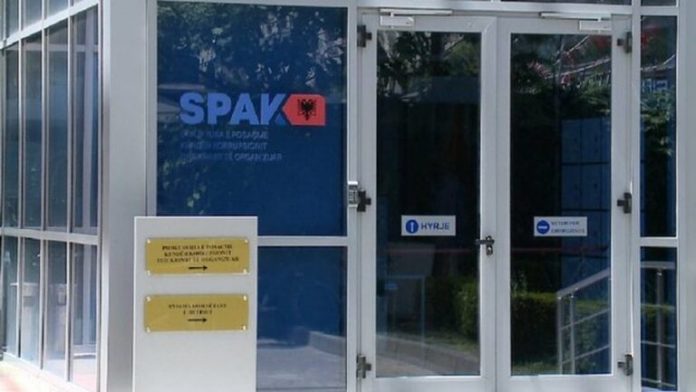
But SPAK does prosecute corruption. Is that not a sign that the system is functioning?
Yes – and that is a central counterargument which must be taken seriously. In recent years SPAK has indeed initiated proceedings against high-ranking political actors. That marks a break with earlier impunity. But when close associates of Rama were involved, after a ‘shower’ of a few months, during which even young ladies were permitted to visit, they were released again or left the country in good time. We call these ‘showcase trials’. It is a typical method also seen in Russia or China.
Examples include former Environment Minister Lefter Koka, who was convicted in connection with the waste-incinerator affair, and former Deputy Prime Minister and Finance Minister Arben Ahmetaj, who was investigated for corruption and money laundering and left the country before he could be arrested, as well as many other actors and friends of Rama. In 2025, investigations also reached the innermost circle of government power, but in the final analysis nothing changes in Albania.
These are not marginal figures. This is the centre of Rama’s executive. For that very reason, the question of equal treatment becomes decisive: is power subjected to the same controls everywhere, or do differences arise according to the political relevance of those affected?
Does corruption therefore amount to a personal allegation against Rama?
Not automatically. Criminal responsibility is individual. Corruption by individual ministers is not proof of the Prime Minister’s personal guilt, but he bears political responsibility and, since he is the patron, he may ultimately have been involved in all of these matters as well. The intelligence-service recordings from the period of the 2017 electoral fraud also recorded Rama’s voice.
And politically, another question arises: how can it be that a political system that has governed since 2013 is repeatedly confronted with serious corruption cases within its own leadership, even though its structure is paternalistic? In Albania, nothing happens in government without Rama’s knowledge and approval, or his omission to act. And why, at the same time, does the perception of corruption again deteriorate according to Transparency International? How can the most corrupt administration in Europe, the Rama government, fight corruption? It cannot do so per se.
That is not a question of criminal liability, but one of institutional responsibility. Albania is degenerating into a banana republic.
And is that precisely what a new protest movement is now directed against?
Henze: Yes. And here I must be clear: by the summer of 2026, the ‘Flamingo Revolution’ is no longer merely an environmental protest with political undertones. It has become a current, nationwide response to the allegation that corruption, economic privilege and political power are too closely intertwined in Albania. The movement began on 30 May 2026 in Zvernec and the Vjosa wetlands as resistance to a government-backed luxury resort in an ecologically highly sensitive area. Within days, the protest spread to Tirana and other cities; the diaspora also mobilised. For weeks, demonstrators gathered daily, in many places every evening at 7 p.m. At the end of June, Deutsche Welle described the movement as Albania’s largest civic protest movement since the fall of communism. The demonstrations continued in July and were directed ever more immediately against the government.
The flamingo thereby became a symbol of far more than nature conservation. Under slogans such as ‘Albania is not for sale’, demonstrators accuse the government of corruption, lack of transparency, favouring politically and economically connected elites, and pursuing policies under which public assets and state decisions are deployed for the benefit of privileged interests. The demands now extend far beyond the resort project: they include comprehensive investigations into allegations of corruption, the repeal of laws criticised as abusive, free and fair elections, a technical transitional government and, expressly, the resignation of the Rama government. This makes the protests a direct political response to a perceived crisis of state integrity – not an environmental campaign that was politicised after the event – and shows that Rama no longer enjoys support among the population, including among those sections that had not previously been politically active.
Is this still a protest against a construction project – or has it become a protest against the system of government?
Henze: By now it is clearly about more than a construction project. The resort was the trigger; corruption and governance have become the political issue. The OSW Centre for Eastern Studies expressly describes an expansion from environmental demands to anti-establishment demands and identifies deeper grievances concerning widespread corruption, vote-buying and rule-of-law deficiencies as underlying causes. The movement now demands not only the end of the project, but political accountability at government level. At the end of July, protests around Parliament even led to clashes with the police. The Albanian police represent the Rama administration – that is increasingly the impression – and Albania is on the road towards a police state. The duration and thematic expansion of the Flamingo Revolution make it one of the most important current reactions within Albanian society to allegations of corruption and concentration of power.
Another element of this pattern is press freedom. What is the situation?
Henze: It is under pressure. Reporters Without Borders ranks Albania 83rd out of 180 countries in the 2026 World Press Freedom Index. Its score has again fallen compared with the previous year.
The organisation describes structural problems: conflicts of interest between politics and business, an inadequate legal framework, politically partisan regulation, and a media landscape in which economic dependencies can impair editorial independence. This does not necessarily result in overt censorship, but it produces a gradual effect: self-censorship and restricted investigative independence.
That is politically decisive because corruption and abuse of power become visible only where the media can report independently. Where the media are economically or politically dependent, the result is not necessarily overt coercion, but a system of subtle restrictions. Albania is degenerating in this respect as well.
What does all of this amount to overall?
Henze: A composite pattern: long-term government dominance since 2013; legitimised by falsified elections, the dismantling of the opposition, recurring corruption proceedings reaching into the government’s own environment; exponential growth in money laundering, drug trafficking, human trafficking and gambling in the heart of Europe; a persistently weak corruption score at Transparency International; an anti-corruption authority that is politicised, while at the same time there is an ongoing debate about equal treatment and political neutrality; declining press freedom and economic-political entanglements in the media; recurring OSCE criticism of administrative advantages and pressure in the electoral process; and now, with the ‘Flamingo Revolution’, a sustained mass social reaction expressly directed against corruption, lack of transparency, oligarchic structures of influence and the government. The people do not want the Rama administration, and the Rama organisation feels legitimised by falsified elections. This is Absurdistan, not Albania.
None of these points, taken alone, proves the existence of an authoritarian system. Taken together, however, they create a political concentration of circumstances that necessarily raises questions about institutional balance, control of power and fair political competition.
Question: What does that mean for the case of Ilir Meta?
Henze: It means that his case cannot be considered in isolation. Meta is an accused person in criminal proceedings whose outcome remains open. But he is also a former President of the Republic and one of the principal political opponents of the current Rama government.
He has been in pre-trial detention for almost two years without a final judgment. His case is therefore unfolding at a political moment in which corruption scandals, weakened press freedom, documented imbalances in electoral competition and an exceptionally visible social counter-movement converge.
The ‘Flamingo Revolution’ considerably intensifies that context. What began on 30 May 2026 as a protest against a specific coastal project in a protected natural area became, within weeks, one of the largest civil-society mobilisations since the end of communism and an open protest against corruption, lack of transparency, privileged elites and the Rama government. The fact that citizens have taken to the streets daily for weeks and demand the government’s resignation, investigations into corruption and new guarantees for free elections does not prove political persecution of Meta. But it is a powerful contemporary indication that the issue of control over power and state integrity has long since moved beyond the traditional opposition and into society at large.
The movement is therefore more than background scenery to the Meta case. It is a contemporary social seismograph for a crisis of confidence in the relationship between the state, government and economic power. The fact that it also criticises parts of the traditional opposition makes it particularly important for this analysis: the protest can no longer be dismissed as a mere party-political campaign. The sovereign is on the streets of Albania demanding the resignation of the Rama administration because, owing to the absence of democratic elections, this cannot be achieved through elections.
The decisive question is therefore not only legal but also political: how robust are Albania’s rule-of-law guarantees when they are tested under political pressure?
Let us return to the political context. Where does state arbitrariness begin here?
Henze: Arbitrariness is not the same as state severity. A state may take a hard line against corruption. A state may prosecute powerful politicians. Under legally defined conditions, it may even place them in pre-trial detention. Provided, that is, that the government was democratically elected and is not itself corrupt. How can the most corrupt administration in Europe, the Rama government, combat corruption? Per se, it cannot.
Arbitrariness begins where the intensity of an interference can no longer be convincingly explained by objective, individualised and proportionate reasons; where like cases are treated differently; where exceptional measures become routine; where procedural guarantees exist formally but erode in practice; or where institutions intended to limit power increasingly become part of the asymmetry of power themselves, as in Albania.
Is the Albanian judiciary politicised?
Henze: As a blanket assertion of fact, that would be too crude. SPAK by no means prosecutes opposition figures exclusively. Prominent representatives of the governing camp have also come within the sights of the anti-corruption justice system. That is a strong counterargument to the idea of a simple chain of command from Rama to every prosecutorial decision. But in Albania under Rama the rule is: he who pays, decides. A paternalistic structure has been implemented; how, in such circumstances, can the judiciary, can SPAK, be independent?
But political independence is not a metaphysical attribute that an institution acquires once and then retains for ever. It must demonstrate itself: in appointment procedures, equal treatment, the choice of coercive measures, the duration of pre-trial detention, the handling of exculpatory material, the comparison between government and opposition, the protection of the defence, and the ability to take decisions that do not please the relevant centre of power.
In a politically highly concentrated system, judicial independence must be especially visible and verifiable. That was built up in Albania until 2013, but it is no longer the case today.
What, then, would constitute real evidence of politically motivated justice? A telephone call from Rama to a prosecutor?
Henze: Not necessarily. And this is precisely where Navalny becomes legally relevant. Article 18 ECHR exists for cases in which a state uses an instrument that is legitimate in itself for another, concealed purpose.
In Navalny’s case, the ECtHR did not find a written Kremlin order saying: ‘Suppress this opposition politician.’ The Court considered the pattern: repetition, sequence, measures that became increasingly difficult to explain, Navalny’s position as an opposition politician, and the broader political context.
That expressly does not mean that the same conclusion can be drawn in Meta’s case today. It does mean, however, that the political misuse of state power may also be inferred in law from an overall assessment of the circumstances.
What does such an overall assessment reveal in Meta’s case?
Henze: It reveals a long political history: a President in fundamental conflict with Rama’s majority; a first impeachment process; international doubts as to whether the required threshold of seriousness had been met; a second attempt at impeachment; a parliamentary majority voting for his removal; a Constitutional Court stopping that step; the regular end of Meta’s presidency; his return to active opposition; his arrest in 2024; continuing pre-trial detention in 2025 and 2026; reports of extensive isolation; and, finally, the written complaint by his lawyers concerning the conditions under which confidential defence consultations took place.
At the same time, international election observers have for years documented structural advantages enjoyed by the governing party, misuse of state resources, political pressure and, most recently, expressly, the absence of a level playing field.
None of those points alone proves political persecution of Meta. But at some point it is no longer sufficient to consider each individual event exclusively in isolation.
Cui bono?
Henze: That is a legitimate political question here – provided it is not confused with proof. Who benefits? Objectively, Meta’s prolonged detention benefits his political opponents. The Rama clan, Balla and the Socialist Party do not, during this period, have to contend with an Ilir Meta who is free to act as an opposition leader.
That does not prove that Rama directly ordered his detention. It does not prove political control of SPAK. It is, initially, only the political effect. There was no intervention; rather, what had for years been attempted by other means was carried through. But that gives rise to a more demanding question: what institutional safeguards must exist where an exercise of state power simultaneously produces an enormous political benefit for the party that has governed for years?
The greater the political benefit, the more important the visible independence of the decision-makers and the rigour of the proportionality assessment must be.
You also see in this a message to society.
Henze: Yes. And here again, the distinction between intention and effect is crucial.
Imagine a mayor, an entrepreneur, a journalist, a civil servant, a young politician or simply an Albanian citizen considering whether publicly to take on the dominant Rama government. He sees a man who has been President, Prime Minister and Speaker of Parliament – and that man has been in pre-trial detention for almost two years.
If, in addition, that man is largely isolated and his lawyers have to fight for confidential communications, a message can emerge without ever being officially pronounced: if even he is so vulnerable in the face of the state, how vulnerable am I? Political systems operate not only through laws. They operate through examples.
Is that precisely where you see the connection with Navalny?
Henze: Yes. Not in equating the two men, but in the logic of political deterrence. The effect of Navalny’s treatment was not directed primarily at Navalny alone. Every Russian activist could observe the personal costs that a fundamental confrontation with the political centre of power in Russia could entail. Executions through heart attacks, falls from windows and poisonings are also cited as examples of methods of intimidation.
There was also a campaign against Navalny concerning corruption and other alleged offences. Ultimately, it was a disinformation campaign intended to neutralise him, as with Meta.
In Meta’s case, such a state purpose can no longer be excluded. Europe should ask itself at a very early stage: when do the costs of effective opposition in a democratic state become so high that their deterrent effect alone destroys political pluralism?
Is that the road to a one-party state?
Henze: Not necessarily. Albania today is not a one-party state in the communist sense. But there is an intermediate zone between liberal competitive democracy and an overt one-party state. Parties, courts, elections and journalism continue to exist there. And yet alternation in power becomes structurally more difficult because reality differs from what the Constitution provides, as is the case in Albania.
A governing party enjoys enormous administrative advantages on a lasting basis. Public-sector employment creates dependencies. Media concentration reduces independent scrutiny. Opposition parties become more fragmented. Their leading figures spend an ever greater share of their energy on court proceedings.
If these factors develop at the same time, a de facto dominant-party system can emerge without any law ever being enacted to ban other parties.
Would the 2019 local elections be an example of that?
Henze: They were, at the very least, an exceptional moment. Following the local elections of 30 June 2019, ODIHR found that, although voting had generally been peaceful and orderly, voters in the political stalemate had no meaningful choice between political options. At the same time, the organisation called for measures to address the long-standing problem of misuse of administrative resources and pressure on voters.
That was not a typical pluralist and democratic local election; it was a non-election. The more important conclusion is this: Albania’s political system has already demonstrated how far polarisation and institutional conflict can hollow out the voters’ real choice.
Why does Europe tolerate developments of this kind?
Henze: Because Albania is strategically convenient for the West and some actors within the EU are also corrupted. That is sharply put, but the dilemma is real. Albania is a reliable NATO member, although we are currently examining whether NATO secrets are also being sold by Albanians. Rama is a familiar figure in Western capitals, a rather unserious and unpredictable interlocutor who always likes to attract attention. The EU and the United States have invested substantial political capital in Albania’s justice reform.
That is precisely how a dangerous blind spot can arise. Anyone who has supported a reform for years wants to believe in its success. Anyone who needs a geopolitical partner tends to interpret that partner’s domestic shortcomings less dramatically than the same shortcomings in an adversary.
For the European Union and Washington it would be normatively fatal if the rule of law were applied strictly to Europe’s opponents and flexibly to its friends.
What should Brussels do?
Henze: It should neither declare Meta a political prisoner nor politically order his release. That would itself be an impermissible interference in ongoing criminal proceedings.
Brussels should demand something less spectacular and more effective: transparency and verifiable rule-of-law standards. The additional ten-point plan of the EU and Germany must be implemented. Rama must be charged in relation to possible involvement in electoral fraud, particularly in 2017.
These are not political demands. They are rule-of-law control questions. This must happen now; Brussels must finally wake up. Criminals from Tirana cannot be sitting at the EU negotiating table on accession.
What would be the one question for Rama?
Answer: First, I would like to speak with him directly one day. And second, not: ‘Is Ilir Meta guilty?’ In a functioning state governed by the rule of law, Rama is not entitled to decide that.
I would ask him: Prime Minister, can you credibly guarantee to the Albanian public and to Europe that a leading member of your own party, on an identical evidential basis, would be subjected to the same duration of pre-trial detention, the same conditions of detention and the same protection – or the same restrictions – in relation to communications with his defence lawyers?
That is the real question of equality.
I would also ask him whether, in the interests of the future of the Albanian nation in Albania, he would be prepared to submit to the democratic and fair process of democratic local and parliamentary elections for the years 2017, 2021 and 2025, if necessary even against himself.
The question for SPAK?
Henze: First, it must be made clear that SPAK is financed by the Albanian state; financially, Rama is its chief. Accordingly, while SPAK is not on paper subordinate to Rama, de facto it is embedded in the patronage structures of the Rama administration under the patron Rama: he who pays, decides.
And if this Rama MAFIA structure, as Europeans describe it, were dismantled, there would first have to be a major clean-up within SPAK and every investigation instigated by the Rama structures would have to be reviewed. And in the meantime? SPAK could cleanse itself by conducting the investigations demanded since 2017 into Rama, his brother Olsi Rama, Balla and several other actors, and by bringing them to criminal account.
Furthermore, SPAK would have to substantiate the criminal suspicion against Ilir Meta and submit it in full to an international panel of experts, which would analyse every detail, including by forensic methods, so that falsification of documents, manipulated witnesses and manipulated factual circumstances could be excluded and the entire conduct of the proceedings could dispel every reasonable doubt that the Socialist Party and its structures, members of the government or the Mafia exercise any influence over the intensity, duration or coercive measures used in the proceedings.
An independent authority cannot demand trust. It must generate trust – through reasoned decisions, equal treatment, transparency and procedures whose fairness remains visible even to its fiercest critic. That is not currently the case, and it must change.
Question: The question for the Ministry of Justice?
The Ministry and its leadership are a catastrophe for the Albanian state. It is more a party ministry of the Socialist Party; in Europe we jokingly call it the PSP. But the simplest question in the entire interview is: Was the camera on?
If not, that should be explained in a technically verifiable way. If so: why? Was there a recording? Was there sound? Who saw the signal? On what legal basis? Was there an external operator of the system? Who, and which company, carries out the maintenance? From whom was the system purchased? Who is responsible for processing and analysing the data? Where are the data stored? What concrete danger justified the measure? And what happened after the letter of 20 July? Who coordinated with whom, when and in what context? Who was strategically, operationally and tactically responsible for the surveillance?
Where there may have been a breach of lawyer-client confidentiality, no political explanation can substitute for a technical answer. In those circumstances, an impartial process conducted in accordance with rule-of-law principles is not guaranteed in Albania. The proceedings against Meta would then have to be discontinued with immediate effect. The Minister of Justice would have to be removed from office and dismissed with immediate effect.
Question: And the question for the EU?
Henze: Perhaps the most uncomfortable one: would Brussels assess the same facts with equal composure if the prisoner were the most prominent opponent of a government that did not geopolitically belong to the Western camp?
If the answer is no, then a double standard exists in Brussels and Washington. And then Albania is not the only place with a rule-of-law problem. Europe and the United States would have a credibility problem. That is unacceptable; the European Parliament should then react immediately.
Question: So is Meta a political prisoner?
Henze: On the basis of the material currently capable of public substantiation, that must be assumed. Meta is a political prisoner.
SPAK apparently has no substantiated evidence; otherwise Meta would long since have been charged and convicted. They apparently also want to wear Meta down through solitary confinement; that comes close to torture. But I believe the former President, a genuine Albanian patriot, will not break. Meta is an accused person in criminal proceedings, charged by an administration that is itself publicly described as a MAFIA government; so what answer do you expect from me?
His political past is controversial. The allegations against him must be examined by a court. SPAK is not an authority that, like the comrades in Moscow or Beijing, mainly prosecutes government opponents for corruption; but it is a fact that the Rama administration has been in power for thirteen years and that money laundering, human trafficking, drug trafficking and corruption are growing exponentially. Why are these developments, at the centre of which Rama and Balla stand as responsible figures, not being pursued centrally? Rama courts have reviewed his detention. All of that forms part of the story.
But the following is equally part of it:
Meta is one of the most prominent opponents of a politically corrupt power that has dominated since 2013. While serving as President, he was already in a fundamental institutional conflict with that majority and prevented anti-democratic developments. The Parliament dominated by Rama attempted to remove him from office. The Constitutional Court stopped the impeachment. He returned to the opposition. Two years later he was arrested. Almost two years after that arrest, he remains in pre-trial detention. Reports describe his detention as almost complete isolation. And there is now a written complaint by his lawyers stating that even confidential defence consultations took place under camera surveillance.
That is not enough for a judgment. But it is more than enough for a serious investigation into the pattern of the criminal governmental organisation in Albania.
Question: What is that pattern, reduced to one sentence?
Henze: A government has dominated for more than a decade. Across several electoral cycles, international observers have documented recurring misuse of administrative resources, pressure on voters and structural advantages for incumbents. The public level of corruption continues to rise and has recently deteriorated again. Leading government representatives themselves become involved in serious corruption proceedings. According to Reporters Without Borders, press freedom has again fallen back. At the same time, a former President and leading opponent of the head of government is held for almost two years before a final judgment – under conditions that raise questions about isolation and surveillance of defence lawyers. Precious protected natural areas, also protected by international treaties, are being sold and bulldozed. There is therefore a danger that Albania will lose not only its young people but also an important part of Albanian DNA: nature, a precious asset that is also important for tourism.
Each of those points can be explained individually. The decisive question is: what emerges from their sum?
Question: Is that the real lesson from Navalny?
Henze: Yes. Russia did not become, in a single day, the state in whose penal colony Alexei Navalny died. Political systems change gradually. Institutions do not always lose their meaning suddenly. Sometimes their names remain, as do their buildings, judicial robes, ballot boxes and parliaments – while at the same time the actual conditions of political competition change. Substance and outcomes are decisive. Paper is patient, and the rule of law, a democracy, consists 30 per cent of technique and 70 per cent of acceptance of that institution by the sovereign, the people. That trust no longer exists in Albania. As a result, the democratic machinery is dysfunctional and the Albanian population’s trust in this state is approaching zero. A democratic state governed by the rule of law therefore no longer exists in Albania at present, per se. Consequently, there can no longer be proceedings governed by the rule of law either.
That is precisely why the Navalny comparison is meaningful only if it is raised early. If Albania were one day genuinely comparable to Russia, the question ‘Is this a Navalny moment?’ would no longer be a courageous question. It would be a belated one.
Your conclusion?
Henze: The rule of law is not measured by how uncompromisingly it can pursue its opponents. It is measured by how uncompromisingly it protects their rights while pursuing them.
A state possesses almost total physical power over a prisoner. It determines when the door opens, when the person may go outside, whom he sees, with whom he speaks, where he sleeps, how long he remains alone and under what conditions he can defend himself against that very state.
That is why a single cell is not a technical detail. A camera in the lawyers’ consultation room is not a technical detail. Almost two years of pre-trial detention is not a technical detail. Nor is the political context a technical detail. None of these elements, taken alone, proves political persecution; taken together, however, they do. In our view, Meta is a political prisoner of the Rama administration.
But democracies rarely erode through a single spectacular act. They erode when a society learns to rationalise each exceptional interference separately – and eventually stops looking at their cumulative effect.
That is the real warning from the case of Alexei Navalny. Albania is not Russia. Ilir Meta is not Navalny. Edi Rama is not Putin. Precisely for that reason, Europe should look closely today – and not only when those sentences one day sound less self-evident.
For the question is no longer merely: what is Ilir Meta accused of? It is also: what is happening to Ilir Meta while his guilt remains unproven? What happens if he dies? There are actors in Albania who would wish for that.
And behind that lies the larger question, extending beyond any one politician: can an opposition in Albania still become powerful enough genuinely to threaten the government without the power of the state itself becoming an existential danger to its leading representatives?
That is Albania’s Navalny moment. Not because the history is already the same, but because Europe still has the opportunity now to ensure that it never becomes so.
What follows politically from this – and what would now have to happen?
Henze: If the developments described are indeed understood as a connected democratic warning signal, it is not enough merely to point to the next ordinary election. In 2026, the Flamingo protests developed from an environmental dispute into a broad anti-government movement; its political demands now include Rama’s resignation and early elections. That is not a footnote, but an expression of an acute crisis of confidence.
The consistent democratic response would not be an extra-institutional transfer of power, but the opposite: a rapid return to the sovereign. Albania should therefore open the way to early, free and democratic parliamentary elections – in full compliance with the Constitution and under exceptionally strong international election observation. An expert government would have to be installed immediately.
Such an election would have to involve more than merely opening polling stations. Albania immediately needs a new electoral law corresponding one-for-one with the requirements of the Venice Commission.
If ODIHR expressly found in 2025 that political competitors did not enjoy a level playing field and that the governing party benefited from the use of public resources and institutional power, that very deficiency must be corrected before a new election. In that respect, local elections should take place in parallel.
International observation should therefore not be confined to election day but should cover the entire process: electoral legislation, party financing, media access, use of state resources, pressure on public-service employees, voter registration, counting, complaints procedures and protection of the secrecy of the ballot.
Meta and other political prisoners would have to be released immediately.
The OSCE/ODIHR, the Parliamentary Assembly of the Council of Europe and the European Parliament have the instruments to accompany such a process closely. A comprehensive international mission would not transfer the political decision abroad. On the contrary, it would help to ensure that the decision genuinely rests with Albanian citizens.
The demand is therefore not that Brussels determine Albania’s government. It is that Albania allow its citizens to decide under conditions in which government and opposition genuinely compete with equal democratic opportunities.
If Rama is convinced that his political majority continues to represent the will of the population despite allegations of corruption, the Flamingo protests, growing criticism of media freedom and the documented electoral asymmetries, there is a democratically unassailable test of that claim: the ballot box.
If he does not recognise that, then there will presumably have to be a democratic revolution, or Albanians might simply strike and all stop work for one day or two days.
And if the opposition claims that the country is increasingly controlled by a dominant power structure, the same test applies to it. It too must seek its legitimacy from the citizens – not in foreign capitals and not solely in street protests.
The strongest response to Albania’s present crisis of confidence would therefore be an immediate political agreement on early democratic elections, to be held after implementation of the central ODIHR recommendations and under comprehensive international observation.
Not in order to take Albania’s sovereignty away, but to return it visibly to the only place where, in a democracy, it ultimately belongs: to the Albanian citizens. They are the people, not Rama and his comrades.
For after all the questions concerning corruption, state resources, press freedom, pre-trial detention, isolation and the treatment of political opponents, what remains in the end is a democratic question simpler than any legal theory.
Who should govern Albania?
Henze: The answer may be given neither by a prosecution authority nor by a prison, neither by a Prime Minister nor by an opposition party.
It belongs to the Albanians – in free elections, under conditions in which every vote genuinely carries equal weight.
Are you a friend of the Albanian nation?
Henze: Yes. In the meantime, as far as the culture and landscape are concerned, I have become half Albanian. I hope the Albanians do not object.