
There is an unusual atmosphere internationally; prospects are now perceived only vaguely – what is your impression?
An irrational mood has also swept through Germany and into the parliaments in recent years; democratic parliamentarianism has lost its role as a stabilising force. Every country needs someone to keep politics on course despite mass hysteria and destabilisation.


“Grey, dear friend, is all theory, and green is the golden tree of life,” says Mephisto in “Faust: Part One” to his perplexed student, who does not know what to study. He then disappears with Faust into the thick of life to settle the wager they have just concluded.
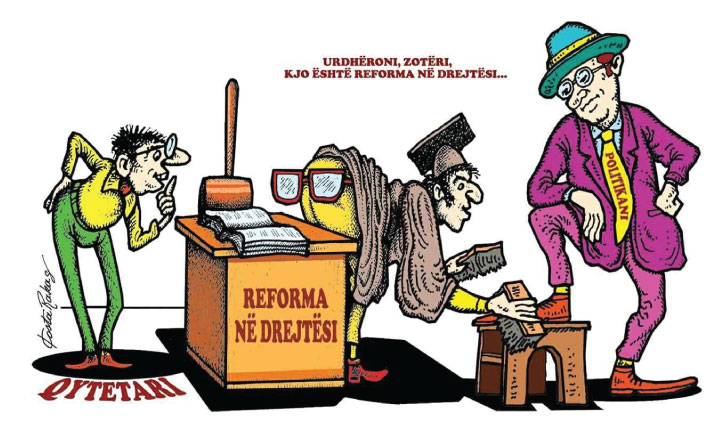
If one is to believe people in Europe and the US, the situation with democracy and the rule of law is actually the other way round. It is a fine idea – most Albanians surveyed agree on this – but its implementation leaves much to be desired.
What could be the reason for this?
It is a fine idea that the people themselves decide what is done. They elect their leaders and can also vote them out if they are dissatisfied.
In practice, however, it often makes no difference who you vote for, because it feels as though you always end up with the same result.
Participatory democracy is fine, but not when it leads to gridlock through self-strangulation, as has been the case in Albania in recent years. A point must be reached where a decision is made. Then action must follow. From the perspective of the discontented, the Albanians, this moment is reached far too late – if at all.
“Reason becomes nonsense, a blessing a curse,” Mephisto warns the student against the idea of studying law. This can also be applied to life in Albania, which is beautiful in itself but ultimately unnecessarily arduous.
This gap between the beautiful idea of Europe and the autocrat Rama’s beautiful propaganda on the one hand, and the grim, foul reality on the other, is simultaneously the gateway to the current national disaster in Albania. Nothing less than the future of the Albanian nation, culture and language is at stake.
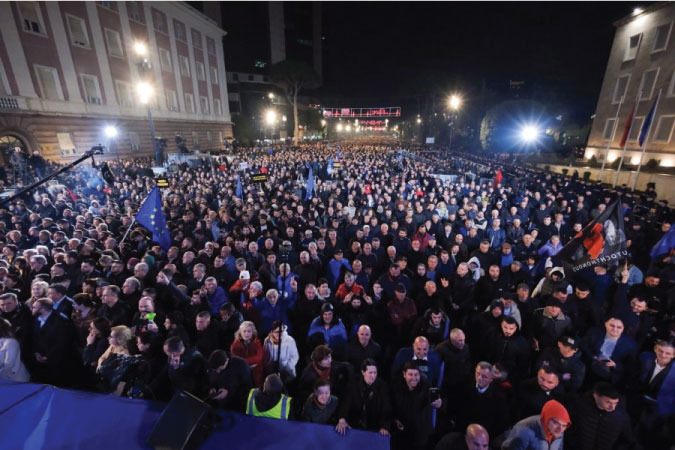
This also explains the drive behind the demonstrations in recent weeks, in which hundreds of thousands of Albanians took part against the Rama regime and were forced to endure the regime’s brutal violence.
The fundamental problem – and this is less about the technicalities of the rule of law in Albania or the EU accession criteria – lies in the horizons of experience.
Those who, like the Albanian nation, experienced the revolution in the early 1990s and the Serbian – and, from 2007, the Serbian-Russian – hybrid destabilisation campaigns in the Balkans between 1993 and 2013, react more sensitively to new impositions. Those who perceive institutions as distant and dysfunctional, and who observe European – indeed, German and European – politicians coming to Albania to preach democracy and anti-corruption whilst confusing the Albanian people and the opposition with Rama, the architect of the disaster of the last 12 years, are more susceptible to an anti-Western, opportunistic and/or tacit acceptance of the status quo.
The vast majority in Albania stands for democracy, prosperity and the right to happiness, as well as for the civilised values of the Western world, but they also expect these to be delivered. Rama does not deliver. European and US politicians and ambassadors apparently like to, as they say in Albania, hold out their hands and have deep pockets.
Albanians are not a homogeneous group. They sometimes have crazy ideas and also emotional young politicians. My life experience tells me: with age comes wisdom. I believe that Albanian politics, too, should honestly admit: have we, in the past, given the impression that we take the concerns of ordinary people in Albania seriously? Have we given people the feeling that they can come to us, that we listen to them and recognise the reality of their lives?
In this respect, even the opposition to the corrupt, autocratic Rama system can do better. This also means distancing itself from the opportunists and figures who have covertly worked for the Rama organisation and/or received favours. I have known Albania since 2008 and have the impression that Albanian civil society and its political arm, the DP, can do much better. They will do better and pull Albania out of the quagmire of the Rama organisation’s criminal structures.

What is the problem facing civil society and its political arm, the Albanian opposition?
Well, that has become very clear in recent years. In Albania, it seems to me to be very difficult to engage in political work when you are committed to a nation whose state has been hijacked by a dictator; either you are restricted, made unemployed, beaten in the street, poisoned, forced into prostitution for a job, shot, or forced to flee.
The EU and Germany, too, speak almost exclusively with official governments; there is hardly any support for the people. Donald Trump has, quite rightly, behaved differently for the past year; we see this in Venezuela, we see this in Iran. That is genuine engagement, but we also see how many European politicians – including Putin’s confidants such as the autocrat Orbán – criticise Trump’s approach.
In doing so, Germans and Europeans on the political stage overlook the most valuable asset of a country: its people. Thus, in Albania too, the doors remain mostly closed. There are invitations to meetings and talks, but what are the results? Ultimately, in Albania, the corrupt Rama system does as it pleases. Is that in our and Albania’s interest? No.
Many Albanian opposition figures cannot return to Albania. They would be arrested or put under pressure by the government mafia, along with their families.
I believe that the Albanian opposition, under its wise leader Sali Berisha, has also realised that it has made mistakes. No one is infallible. What is far more important, however, is that it sends clear and courageous signals to the Western world and to Rama: the Albanian nation does not belong to Rama. Ultimately, it is about safeguarding our identity and freeing ourselves from the paralysing fear that prevails in Albania, so that we may find the courage to overthrow this regime.
Are the actions of the Albanian nation and the political opposition actually putting pressure on Rama?
Rama, his brother Olsi, Balla, Basha, Tabaku and the other figures who also took part in the attack on the opposition on 8 January 2022 are a thing of the past. Their time is up. Even within his own circle, among his family and friends, there is likely to be whispering about what will happen next. A candidate close to Rama or the democratic forces of Albania? In the end, it comes down to who can hold out the longest. The Albanian opposition must remain very strong and must not, at this stage, engage in leadership disputes, which the autocrat Rama repeatedly attempts to instigate through his agents within the opposition who pose as opposition figures.
The Albanian opposition must now present a united front. What is essential is that it needs allies who will take the offensive. This is where Germany and the US are called upon to change their policy. If we resolve this conflict, remove Rama from office and, after 12 years of oppression, return to free elections in Albania, it will bring about significant change in Albania and across the Balkans. So let us begin here together. Internationally, Rama is viewed by many as a figure who cannot be taken seriously, and his conduct reinforces the view that Albania is a lost cause for civilisation. Some Western politicians and ambassadors are therefore still happy to accept cash gifts from the autocrats. This situation will persist until Albania changes. I have the impression that Albania is ready for the post-Rama era and will gain EU membership if a change of government takes place now.
It is up to the Albanian nation to remove the Rama administration, which has been operating without legitimacy for twelve years, through free self-determination.
Is Rama a follower of Vucic?
Yes. Behind the scenes and within the framework of the Russian ‘Open Balkan’ project, certainly. By origin, he is not Albanian. It is only in the repression of the Albanian people that he still acts independently. It is not without reason that around one million Albanians – a third of Albania’s total population – have fled the regime over the last 12 years, are working in Europe and the US, and/or have applied for asylum there. This is a disaster for Albania’s future and for the Albanian families that have been torn apart as a result.
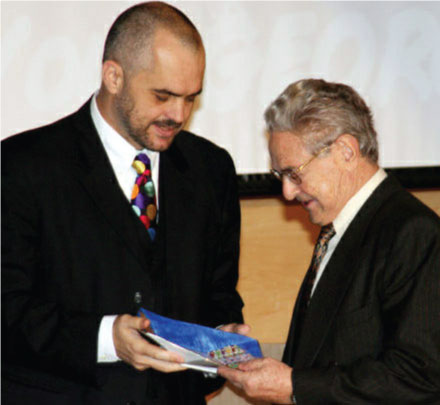
Some political forces in Europe and the Soros faction in the US claim that the Rama mafia government – as it is dubbed by Europe’s largest daily newspaper – would evolve into a democratic constitutional state through reforms and aid funds.
But why should this Rama administration change when doing so risks its own self-destruction and long prison sentences for its clans?
The international community believed that it could, in effect, re-educate him through international integration. However, this is an illusion. When I look at the results of this Western policy, I see that a great deal of taxpayers’ money from Germany and the US has flowed into the pockets of the Rama administration and that Albania has become a hub for money laundering and drug logistics. Rama acts in the interests of his clans. He does not care about Albania or its people. He treats them like children or corrupts them. He is interested only in his own survival. Any attempt at cooperation by the US, the EU or Germany will be exploited by him, his clan members and his comrades – who sail under false colours in the opposition – solely for their own benefit. These people will return the embezzled capital neither to us nor to the Albanian people. Anyone who tries will end up looking like a fool. Our Western political colleagues are succumbing to a ghostly self-delusion. A fundamental realignment of Western policy is therefore required, and the Albanian people now have the task of reclaiming their legitimate power.
The decisive dividing line runs between authoritarian regimes and those in which everyone enjoys the same civil rights, regardless of their political stance, regardless of whether they think the government is brilliant or detestable.

How can one really tell what the mood and the actual situation are like in Albania?
By the repression, the refugee figures, and the corruption and press freedom indices, which have risen massively again in 2025.
Why are there more refugees in Albania now than in the 1990s? If we look only at the mass demonstrations of recent weeks, the likes of which have not been seen for years, this proves that the approval propagated by Rama is a façade. The actions of the regime in Tirana speak louder than any rigged election since 2013 or the statements of Western politicians.
Are you concerned about the new generation in Albania, which is today exposed to massive propaganda or being corrupted by the system?
Indoctrination and corruption are, in the long term, among the most dangerous developments in any dictatorship, including in Albania. Yet even decades of propaganda and terror could not prevent mass protests in Tirana in 1991 and in the GDR in 1989. A similar signal is now coming from the Albanian opposition led by Sali Berisha, who had already led the revolution against communism in Albania in 1991. Hundreds of thousands have now taken to the streets again in Albania. They are saying no to the theft of Albania’s future, to corruption and to election rigging.
To me, this is a very strong sign of hope for the overthrow of the illegal Rama regime. The younger generations have grown up with a relatively free internet, despite massive restrictions on press freedom imposed by the Rama regime. They represent a significant majority for any positive change in Albania.
Have Europe, Berlin and Washington reacted too weakly? Were the calls for dialogue and compromise a mistake?
Yes, it is rather strange that France, the United Kingdom and Berlin mocked the fact that, on the odd occasion, a Molotov cocktail is thrown during Albanian mass protests – usually organised by a provocateur from the Albanian administration. When I look at the protests in Europe and the US over agricultural reforms and the G7/G20 summits, the events in Albania are profoundly peaceful by comparison. Yet there, the aim is the overthrow of the dictatorship. I think the ambassadors in Albania should not comment critically on this, as they themselves sit in a glass box at which stones are not usually thrown.
Years of Western appeasement and engagement have emboldened Rama – from Biden and Blinken to Meloni and Berlin.
The lesson is clear: concessions to dictators and autocrats encourage aggression and oppression. Since 2013, the EU and Berlin have issued nothing but symbolic statements, culminating in the interventionist fraternisation of the then US Ambassador Kim with the socialist autocrat Rama.
Even today, Rama and his supporters are still partly believed, despite their methods of flattery, gifts and empty promises. The reality, however, is quite different: a corrupt government, dysfunctional judicial and legislative branches, rigged elections, mass exodus of the population, suppression of the opposition, and curtailment of press freedom. Whilst Rama talks, he continues to wage war against democracy and EU accession in Albania.
The time for appeasement and downplaying the Rama regime should also be over in Europe and the US. There must now be resolute support for the Albanian opposition. Drug regimes and corrupt autocracies have no place at the heart of Europe.
Did a lack of historical awareness in Albania also lead to the current situation?
Yes. “Don’t know much about history” was a hit in the sixties and seventies; love was the defining theme. Today, consumerism and the iPhone are more important than education. A lack of historical awareness characterises Albanian education and, increasingly, some German schools too, where only one hour of history is taught per week – and often by teachers who are not specialists in the subject.
Why bother with history at all? Quite simply, we stand on the shoulders of generations, and it is essential that every new generation is not only familiar with the present, but also understands the past and the recent past in order to recognise connections and causes. This scourge of historical amnesia and the failure to recognise connections and patterns must be broken. In this respect, it would be desirable, following the fall of Rama’s autocracy, not only to restore the functioning of the judiciary, legislature and executive and ensure that the economy is thriving, but also to implement a fundamental overhaul of the Albanian education system.
My political mentor, Helmut Kohl, once summed it up aptly: “Those who do not know history cannot understand the present or shape the future.”
We are talking here about the dawn of a forward-looking Balkan region, an end to oppression in the Balkans.
How do you assess the current global situation from a German perspective?
Well, we are adapting to a new global situation and are in the process of developing the EU into a centre of power.
Trump’s initiatives in Venezuela and Iran are the right ones. It is unacceptable that the ‘axis of evil’ – Putin, Kim and the mullahs – should use the protection of international law and the UN to shield their dictatorships and expand their spheres of influence. President Trump is doing a good job in these turbulent times, even if he sometimes seems very unpredictable. Trump’s problem is that he is, unfortunately, surrounded by some very poor advisers. I hope that this will change.
We are currently in the process of developing traditional international law into a robust system of international law.
However, it is also important, given the ongoing US actions in Iran, Venezuela and Ukraine, to have a strategy for freedom, to define several procedural steps and to maintain continuity of objectives. I believe that German Chancellor Friedrich Merz and US President Donald Trump are not only good friends, but also share a common understanding of how we must protect our freedom together.
What happens if the mullahs’ regime collapses?
We are standing at this tipping point, despite the disinformation campaigns from Moscow and Tehran, and the good news is: President Trump is willing to topple the mullahs’ regime.
Iran, but also the Vučić government in Belgrade and Orbán in Budapest, are de facto proxies of Putin. If the mullahs fall, Moscow’s support for its war crimes in Ukraine and the Balkans will collapse. Russia would then have to withdraw from Ukraine, and the autocrats Rama and Vučić would likely be deposed by their own peoples. Following the collapse of the mullahs’ regime, the Middle East could develop into a peaceful and very strong economic region, without the threat of a nuclear bomb. That is an interesting and positive prospect.
What are the economic and financial difficulties facing the Albanian state?
Well, there are many important reasons. A primary problem is the corruption within the administration and the Rama family clans. The Albanian state has degenerated into a bank for the Rama family and their friends.
Investments of dirty money from drug deals, laundered through loans from Albanian banks, are the main driver of growth in Albania. Albanian local authorities and social security funds lack the money, as it never reaches them. Enormous currency speculation and bond schemes are being organised. I get the impression that the Albanian National Bank has degenerated into a casino for the Rama clan. Such a system strongly reminds me of what is happening in Venezuela, Iran or Russia. This cannot end well and is unacceptable to the US and Europe.
What do you think of the investment projects in Albanian nature reserves?
Nothing. Alongside its culture and impressive people, Albania has the gorges and mountains of northern Albania, the wetlands and the coastal landscapes. They are a great treasure of Europe and have the potential to turn Albania into the Switzerland of the Balkans.
The industrialisation and destruction of these areas – such as the Vjosa River delta, the construction of the airport in Vlora or the Durrës region, as well as the deforestation of Albanian forests by the Italians – have led, over the past 12 years, to Albania’s forests losing around a third of their timber biomass. The 2016 moratorium did not stop the deforestation. On the contrary.
In March 2023, following years of campaigning by the EU and Albanian civil society, the Vjosa and its tributaries were designated as Europe’s first wild river national park.
Yet this national park is being commercialised by the Rama government. Along the Shushica, a major tributary of the Vjosa, several kilometres of pipes have already been laid to divert the Shushica’s water to the Albanian coast. In the Vjosa delta and in the immediate vicinity of the Narta lagoon, work is also proceeding at full speed on the planned Vlora airport. For the airport construction, which is intended to attract many tourists to southern Albania, new boundaries were drawn as part of a highly controversial, and possibly even unlawful, amendment to the law, thereby ‘carving out’ the construction area from the protected zone. Such a project in the midst of one of Europe’s most important wetlands for birds is absurd.
The planned construction of the international Vlora airport within the Narta protected area is a clear sign of how the Albanian administration deals with international and national obligations. These natural treasures are promoted solely to attract tourists, yet at the same time they are being destroyed.
The disregard for national and international laws, the Bern Convention, the scientific community and European institutions is proof that the talk of nature and ecotourism at international events such as the ITB by Rama and his Socialists is merely a green façade concealing the destruction of Albania’s unique natural environment. The culture and people of Albania have always had an osmotic relationship with nature . To put it simply: if you destroy nature, you destroy Albanian DNA.
Albania last attracted attention in the tourism sector when Donald Trump’s son-in-law, Jared Kushner, was granted a licence by the Albanian government to build a luxury resort on the unspoilt island of Sazan. This is surely an attempt by the corrupt executive, Rama, to win Trump over to his side, just as was done with Blinken. Rama and his friend Soros junior appear to be actively involved. Jared Kushner will know that he must not get involved with these structures in Albania, as he would otherwise become vulnerable to blackmail.
It all looks as though Rama, in his announcement to make Albania a ‘tourism champion’, is showing no regard for nature whatsoever and is thus destroying the very foundations of tourism. This appears to be solely about quick profits for the clans within the Rama administration. Water is being diverted from unspoilt rivers, valuable wetlands are making way for airports, and the sell-off of the country’s last remaining wild coastlines and mountains – Albania’s unique selling point – has begun. History shows the drastic consequences that the destruction of nature can have for a country.
You have political ties to the Albanian DP and its founder, Sali Berisha.
Yes, that’s right; Sali Berisha and I are good friends and we are united by our conservatism.
I hold Berisha in high regard: an upright, tradition-conscious, strong Albanian, a family man and a European in the best sense of the word.
I see myself as a liberal conservative in the tradition of Edmund Burke. He stood for a reform-oriented conservatism that did not seek to cling to the status quo. Every enlightened conservative knows that the paradise of the past was no such thing. The question is how to shape change in such a way that people can keep up. When I studied the English Conservatives of the 19th century, I was struck by the inherent humanity in their reform-oriented approach.
What always repelled me was the cutting coldness of thinking in the categories of the problematic German Carl Schmitt. On the other hand, I reject the idea of a new man, as advocated by Nietzsche.
Human beings are, after all, made of crooked wood. We Germans and Albanians are bound by our shared DNA, and trying to turn that into straight beams simply cannot work.
Conservatives and progressives need one another, and progress arises from the friction between them. This is true, even if it is not usually apparent in the heat of political debate, but only when one takes a step back.
My litmus test is Abraham Lincoln: in 1863, would I have supported the emancipation of the slaves as part of Team Lincoln, or would I have overlooked the need for change?
I do not wish to stand here and claim that I would certainly have supported Lincoln; I can only hope so. That is the thorn in my side. Doubters and people like Hamlet have shaped our civilisation into something wonderful. Hamlet knows that no one has a monopoly on the truth. That is the crucial difference from the political approach of autocrats who believe they know the truth.
We conservatives, a large proportion of US Democrats and Republicans, and the DP in Albania, on the other hand, know that what we consider irrefutable today may seem terribly wrong tomorrow. That is the real reason why democracy is needed, in Albania too: people are not God. Because imperfect ideas only improve through competition. There is no democracy in Albania, as every parliamentary and local election since 2013 has been rigged. Under Rama, therefore, there is stagnation in every form.
Simply imposing one’s own ideas – that is the totalitarian temptation of Putin, Beijing, Tehran – but also of Rama.
In summary, it can be said that Rama’s policies in Albania are a tactic to destabilise democracy, freedom, justice and the right to happiness from within, by deepening divisions and normalising anti-democratic positions as well as criminality in the form of corruption, drug trafficking and money laundering. For example, the German Green politician Rezzo Schlauch, a friend of the Albanian dictator Rama, is a member of the supervisory board of an Albanian bank in Tirana that is at the centre of European money laundering. In this respect, upright Republicans and Democrats in the West should now stand up together with the Albanians and put an end to the machinations of Rama and his comrades.
Drugs, money laundering and power under Rama?
Under the leadership of Rama’s administration, Albania has not only remained a poor and weak country, but has also become a strategic hub for drug trafficking and money laundering. This is not an extremist accusation, but an internationally recognised view held by security circles and other experts, which has never been convincingly refuted.
For years, Albania has been regarded as a transit and source country for large quantities of cocaine and cannabis. These operations cannot function without protection. Not without logistics. And not without political incompetence.
Drug cartels need ports, roads, police, customs, banks and property markets. And precisely where the state ought to be exercising control, many Albanians see a turning of a blind eye, delays or selective enforcement. Whilst small-time dealers and other players who have no insight into the corridors of power are exposed, the structures behind them remain remarkably stable.
The drug money does not disappear. It is laundered. Into concrete. Into luxury property. Into anonymous companies, public contracts and ‘investments’. The construction boom in Tirana is not a sign of healthy growth, but a symbol of unaccounted-for cash flows. Skyscrapers are shooting up faster than incomes are rising, prices faster than any real demand. A state that were serious about combating money laundering could not ignore this discrepancy. Rama does.
And then there is his socialism – not as an ideology of justice, but as a technique of power, devoid of morality and responsibility towards the Albanian nation.
A socialism of words, not deeds, devoid of morality. A state that pretends to speak for the poor, for the nation, whilst protecting a system in which a few, drawn solely from his clan, become extremely wealthy, and the majority of Albanians stand no chance.
Investments of dirty money from drug deals, laundered through loans from Albanian banks, are the main driver of growth in Albania. Albanian local authorities and social security funds lack the money, as it never reaches them. Enormous currency speculation and bond deals are being organised. I get the impression that the Albanian National Bank has degenerated into a casino. Such a system strongly reminds me of what is happening in Venezuela, Iran or Russia. This cannot end well and is unacceptable to the US and Europe.
This creates a dangerous triad: criminal capital provides the money, political power offers protection, and social rhetoric serves to placate. This is not a modern state. It is a system riddled with mafia-like elements, with a socialist veneer. Albania has been transformed over the last twelve years using drug money. The EU, Blinken and Rama talk of reforms, whilst money laundering flourishes.
They speak of social justice, whilst young people are emigrating en masse because connections count for more than skills.
No one is asking for perfection. But one expects a government that fights crime, rather than one under which it thrives.
As long as the drug trade remains economically powerful, money laundering is visible in the urban landscape, and socialist rhetoric masks the concentration of power, Albania will not be perceived as a European democracy, but as a state where power, money and crime lie dangerously close together.
And for this, the Rama clan bears direct responsibility, whilst the political institutions of the EU and the US bear political – yes. Responsibility.
Rama’s narco-state?
Yes. Where the police, the public prosecutor’s office and the administration are perceived not as incorruptible opponents of the mafia, but as negotiable entities, where the legislative and judicial branches are dysfunctional, the basic civilised rules of morality and decency are trampled underfoot.
Particularly damaging is the impression of selective prosecution in Albania, where Albanian opposition figures are being imprisoned in droves on the basis of fabricated charges. Whilst minor offenders are paraded to simulate a capacity for action, many key figures within the Rama administration remain unchallenged for a surprisingly long time. Incidentally, in Albania the opposition is being prosecuted by these perpetrators using forged documents, just as in Russia. This is not the rule of law at work, but merely damage control.
The international perception of Albania suffers not from prejudice, but from facts: drug routes, money laundering, a property boom without proper proof of origin, and the political proximity between economic power and the government are to blame. None of this arises in a vacuum. It thrives where the political leadership looks the other way or derives benefits from it.
There has been no question of European integration for the past twelve years. Rama himself could not recall any of the EU’s ten accession criteria as early as 2019. He seemed to be suffering from political dementia even then.
Yet the EU is incompatible with a state perceived as a transit point for criminal capital. Europe is incompatible with political power that is not radically transparent. Europe is incompatible with governments that tolerate the suspicion of coexisting with mafia-like structures.
The most dangerous damage caused by his administration is not a single crime or the theft of German, US and EU aid payments through corruption. The boundary between the state, organised crime and economic power cliques has been dissolved in Albania over the last 12 years of the Rama administration, to the benefit of the Rama clans. This is not about individual scandals. It is about a pattern.
The same questions keep cropping up: Why do suspected mafia networks find their way into local administrations? Why are mayors, civil servants and MPs with criminal backgrounds only held politically accountable at a late stage – or not at all? Why do major projects, concessions and urban development schemes so conspicuously often benefit actors who have been linked for years to money laundering, drug trafficking or protection rackets?
A democratic state combats organised crime proactively. A criminal state, on the other hand, tolerates it and profits from it.
The current Rama administration bears political responsibility for a system in which criminal networks have access, protection and influence, and in which international aid funds are being stolen on a massive scale. A system in which the police, the public prosecutor’s office and the administration are not perceived as incorruptible opponents of the mafia, but as entities open to negotiation.
It is the normalisation of suspicion. The feeling arises that crime is no longer an enemy of the state, but part of its ecosystem, in which morality and other civilisational principles no longer apply. This is one of the primary problems facing Albania in 2026.
As long as these questions remain unanswered, as long as the patron Rama rules and legitimises himself through rigged elections rather than institutions, and as long as loyalty is protected more than the law, Albania will not be perceived as a constitutional state, but as a risk. The functionality of the constitutional state does not depend on technical issues, but two-thirds on acceptance by the population.
A state can survive poverty. It can overcome instability. However, a state riddled with organised crime loses its soul and its morals. As the former leader of the Socialist Party, Nano, rightly points out, Rama has no morals.
Albania’s future depends on a strong rule of law, a clear separation of powers, and a political culture that does not declare opponents to be enemies and does not plunder the state.
The Rama administration has delegitimised this foundation, which was established in Albania between 1991 and 2013 with massive assistance from the US and Germany. The debate in Albania should therefore no longer be about left or right. It is about responsibility, moderation and respect for institutions, as well as the future of the Albanian nation. Albanians should protect themselves – including from those who come to power through manipulation – and assert their constitutional right to self-defence against the illegitimate Rama administration.
When will you be back in Albania?
Unfortunately, I am travelling a great deal again this year for work. I still have to go to Iraq, the US and several EU countries, including Eastern Europe. However, there are numerous regions in Albania that I have unfortunately not yet explored. These include, in particular, Lake Ohrid, some parts of northern Albania and the south of the country. Even close friends have had to wait, which is not good. Provided that the timing works out, however, a reunion can be expected soon.